

Ground Potential Rise (GPR) backflash refers to the phenomenon where, during a lightning strike or other strong electrical interference event, the lightning current or overvoltage is discharged through the grounding system, causing a significant rise in ground potential. This elevated potential then propagates back through the grounding network into system equipment, forming a "backflash" effect.
Power System Damage
When the ground potential suddenly rises, the transformer's neutral point may break down to the phase conductor. In severe cases, this can lead to phase-to-phase short circuits, transformer burnout, or even explosion.
Damage to Weak Current System Equipment
Low-voltage equipment in communication, security, and data systems is extremely sensitive to ground potential changes. GPR backflash can cause a sudden rise in the potential of protective or operational grounds in signal systems, inducing reverse currents in data and signal lines, which may burn out network equipment, cameras, and control systems.
Grounding Failure Leading to Cascading Faults
In lightning strike conditions, conventional grounding systems may fail to effectively discharge high currents, instead becoming a backflash pathway and triggering cascading faults in the power distribution system.
Ground Potential Conduction from Lightning Strikes
Within a grounding system, the high ground potential generated by lightning strikes can spread through the grounding network to nearby equipment or buildings, causing regional equipment failures or communication outages.
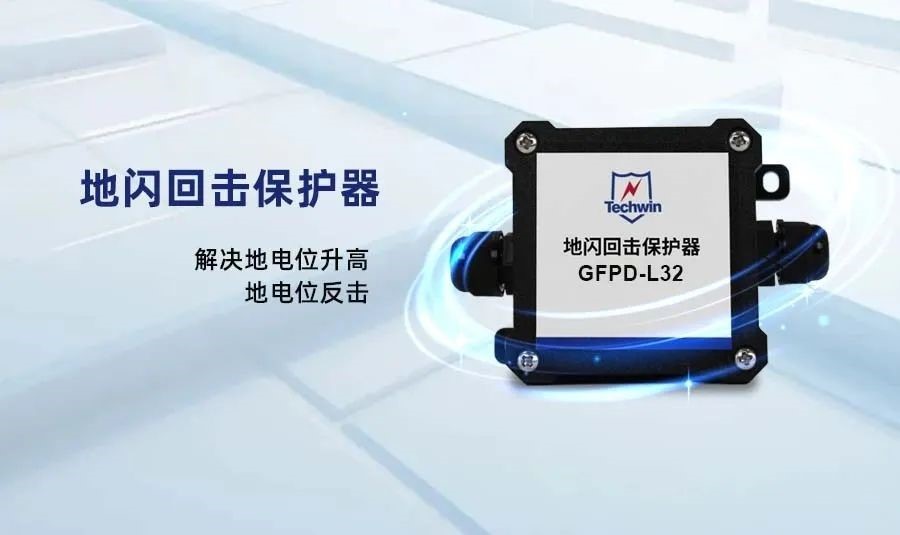
To effectively address this hidden hazard, it is recommended to use a Ground Backflash Protector (Ground Potential Rise Backflash Protection Device). This product is specifically designed to prevent lightning currents from propagating backward along the grounding system into equipment. It is widely applied in substations, base stations, communication equipment rooms, low-voltage equipment aggregation areas, and intelligent terminal control centers.
Through systematic integration, it not only effectively blocks the path of GPR backflash but also significantly enhances the electrical isolation performance and stability of the entire lightning protection system.
Ground Potential Rise backflash is an often-overlooked yet highly destructive "invisible killer" in lightning disasters. Once it occurs, it not only directly damages equipment but also undermines the integrity of the entire lightning protection system. In high lightning-risk areas, only by deploying professional backflash protection measures in advance can a true system-level safety barrier be established.
 Where to install surge protectors in a solar power systemMarch 14, 2023viewThe Meanings of Uc and Up on AC Power SPD and How to ChooseJuly 3, 2024Power surge protectors, also known as power lightning protectors, are suitable for AC 50/60Hz power supply systems and can protect the power systems of residential homes, tertiary industries, and indu...viewIntegrated Lightning Protection Solution: Surge Protector for CCTV CameraJune 26, 2024CCTV video surveillance systems can be used for CCTV video surveillance systems. To ensure that the CCTV video surveillance system can operate continuously and stably, it is essential to integrate lig...viewWhat is a Surge Protector?October 25, 20211. Surge protectorA surge protector is a small electrical device with two functions. The first function is to allow multiple components to be plugged into the same power outlet. The second function, w...viewThe Principle of Surge Protector Lightning ProtectionSeptember 18, 2021The energy of lightning is huge, and lightning strikes can lead to casualties and property damage. With the development of technology, mankind has developed many lightning protection products to prote...viewIntroduction to Signal Surge Protector and Its Lightning Protection FunctionMarch 4, 2022A signal surge protector is a type of surge protection devices that is linked in series on a signal line to reduce transient over-voltages and deflect surge currents away from the signal line. Signal ...view
 EN
EN
 jp
jp  ko
ko  fr
fr  de
de  es
es  it
it  ru
ru  pt
pt  ar
ar  vi
vi  th
th  ro
ro  bg
bg  nl
nl